Sunday, September 1, 2013

Gilded Ghent

I hosted a long-awaited visitor last week-- my mom! I've been waiting for her to come to Europe for the past two years, and she's been waiting to cross the big pond for much longer. I gave her a whirlwind tour of some of my favorite places in The Netherlands, Germany, and Belgium. We had a wonderful time and the weather was on its best behavior. I only wish she could have stayed longer but I'm grateful for the time we had together, and for being able to celebrate her birthday with her for the first time in three years!

Out of all of the cities we visited, the only one I hadn't been to yet was Ghent in Belgium. It seems as if Ghent always comes up in a discussion regarding Bruges. You tell someone, "Oh, I just got back from Bruges! It was lovely!" If they have been to Ghent, their response might be, "Bruges? Well, sure, Bruges is nice but Ghent is where you should really go!"

I do love Bruges but I'd just visited for the second time a few months ago so I decided to take Mom somewhere neither of us had been. Ghent offered the possibility of new adventures and I was also ready to settle the 'Ghent vs. Bruges' debate once and for all.

We took the train from Maastricht early one morning. Once we arrived, we hailed a taxi that drove us to our hotel: the Sandton Grand Hotel Reylof. It's one of those artsy/designy/deco-ish places with garish animal-print covered chairs, wacky chandeliers, and color-blocked carpet that has the special power to make you feel dizzy and get you lost in never-ending corridors. It was sort of like being on the set of Beetlejuice. I loved it. The price was right (for a Monday night) and the location was perfect. All of the staff were kind and the room was large by European standards. I think the fares rise significantly during the weekend but if you find yourself in Ghent during an off-day, it's a great choice.

After we checked in to the hotel, we set off to find out what makes Ghent so special (and more special than Bruges, according to some). Our first view of Ghent, from St. Michael's Bridge, wasn't disappointing.


After a quick lunch of Flemish beef stew, we decided to visit Gravensteen Castle, or Castle of the Counts. I was really excited to visit a castle that's still so intact, and right in the center of a bustling city. The foreboding facade made me feel small and vulnerable as we approached. Gravensteen was built in 1180 with all of the amenities necessary in the Middle Ages.

Gravensteen Castle

The MTV Cribs episode would go something like this:
"Hi, I'm Count Philip of Alsace. Welcome to my crib. Don't mind the screams from the dungeons- ha ha! To the left is the gatehouse, which also served as a temporary prison. And here's the torture chamber, an obligatory addition to any medieval crib. This is the banquet hall where the countess and me hang out and host parties. And these are the toilets, should the need arise. Do you want to see what's in my fridge or would you rather tour the underground prison first?"

Guillotine
Master Bathroom


Throne Room
I really enjoyed the views of Ghent from the battlements of Gravensteen. It was easy to imagine myself back in the Middle Ages, knights and maidens wandering around the endless corridors. The size of the castle was what really struck me the most. It was obviously a very powerful stronghold in its time. 


After our time travel, we strolled through the Patershol quarter, an important area of the city during the Middle Ages that has experienced a renaissance during the past 30 years. It's a lovely, quiet district that is now mainly residential and boasts a few Michelin-starred restaurants.

Back in the city center, the Castle of Gerald the Devil is a must-see for architecture aficionados. It was constructed in the 13th century by a villain named Gerald. He was called "the devil" because of his dark appearance. The castle has worn many hats over the centuries. It's been a knights' residence, monastery, orphanage, school, fire station, and madhouse-- and that's just to name a few. Today, the Castle of Gerald the Devil is home to the State Archives. 
We also visited Saint Bavo's Cathedral. It dates back to the Chapel of Saint John the Baptist in 942. The church underwent rebuilding during the 14th to 16th centuries. What we see today is very close to the way it looked in the mid-16th century. Restoration of the tower began this past May. It's projected to take five years. It was a little disappointing that the facade was covered in scaffolding but I suppose centuries-old cathedrals need some serious repairs every few decades.
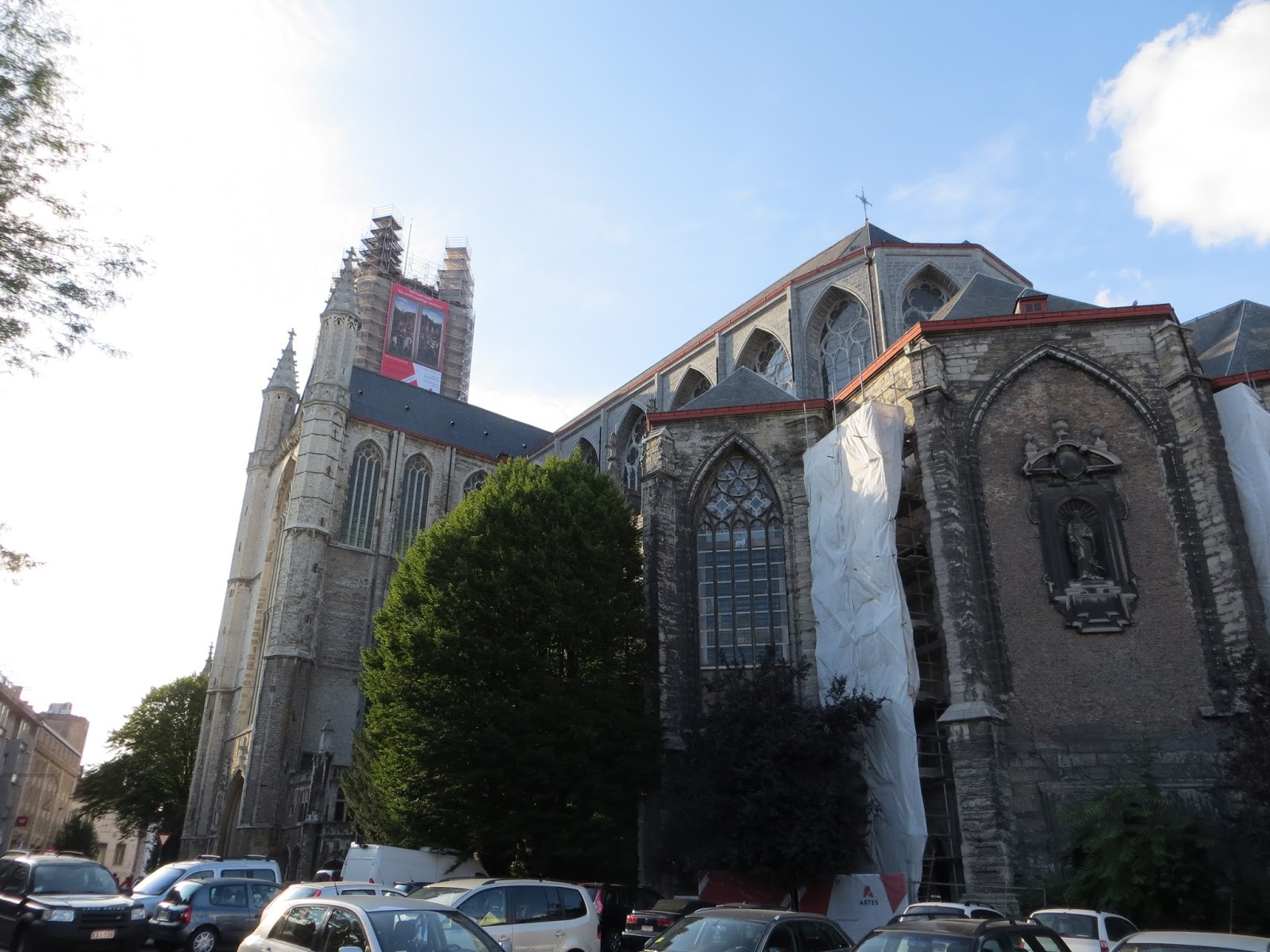
Saint Bavo's Cathedral
The major draw for tourists to Saint Bravo's Cathedral is housed in a tiny chapel off to the side. The Adoration of the Mystic Lamb is an altarpiece painted in 1432 by the famous Van Eyck brothers. Jan van Eyck is considered one of the best Northern European painters of the 15th century. He paired up with his older brother, Hubert, to create the masterpiece some regard as the first great oil painting. We paid a few Euros to see the painting in all its glory. The altarpiece dominated the tiny chapel and throngs of hushed tourists gazed upon it in awed silence. It's all original, except for the 'Just Judges' panel that was stolen in 1934. NPR has a very good article regarding the piece: Is This the World's Most Coveted Painting? 

Van Eyck Bros. Monument
We visited the Design Museum the next morning before we left for Brussels. It mainly offers 20th century and modern-day exhibitions. The focus is on furniture and home accessories. I think it's probably a young design student's dream. Everything from porcelain and china to vases and chandeliers are displayed in the airy interior of the museum. It's nothing you would expect to see housed inside an 18th century building. My favorite collection was in the basement, an exhibition of sheet music illustrated by Peter de Greef. He was a Belgian designer of musical scores between the 1920's and 50's. 

I thought Ghent was lovely. I don't really know a way to compare or contrast it with Bruges. It's more fun and interesting to visit a new place without having expectations or opinions about it based upon somewhere else. Both cites are charming and picturesque in their own ways.

I think, if you're in the position to be judging Bruges and Ghent against each other, you are a very fortunate person because you've been able to walk along the canal-lined streets of both beautiful cities. Savor it, world traveler. You're luckier than most.


Wednesday, August 7, 2013

A Toast (Skal) to Copenhagen!

The last full day in Copenhagen was a whirlwind. We decided to go to the Danish Postal Museum first. On display is everything from the "Ordinance concerning Postmen," signed in 1624, to a room filled with the first cell phones. I saw my old Motorola StarTAC, so that was very nostalgic. We didn't spend too long in the museum because our primary destination was Cafe Hovedtelegrafen on the top of the building. The view of Copenhagen was spectacular, and one of the best parts about the Postal Museum is that it's free! If I had children, I'm sure I would have lingered because of the kid-friendly exhibits and atmosphere. It isn't a must-do, but if you want a bird's-eye view of the city for only the price of a coffee or tea, put the Postal Museum on your list.

Next we took a walk around the palace complex. Amalienborg Palace was built in the 1700's. The grounds consist of four identical buildings surrounding a courtyard. It is the Queen's main residence, but we didn't see the flag raised so I guess she was Queening elsewhere the day we visited. The grounds were overflowing with tourists and we decided against going inside so we could fulfill other places on our "To-See" list.

Palace

We wandered over to Nyhavn, a picturesque canal district dating back to 1681. The oldest house in the area is in Nyhavn and it's also where Hans Christian Andersen lived (in several different houses). It's simple to see how he would choose Nyhavn as his residence; who wouldn't be inspired by the colorful facades reflecting in the harbor? As you'd imagine, the streets here were also packed with tourists but I think Nyhavn is what I imagined when I thought of Copenhagen. It was truly beautiful and easy to see what it must have been like hundreds of years ago, even if it is a bit commercial now.

Speaking of Hans, it's time to see Copenhagen's most famous tourist attraction: The Little Mermaid. I think we all know the story of The Little Mermaid but contrary to popular belief, Walt Disney is not the author. On a side note -- Anton told me that can be one of the most annoying things about tourists in Copenhagen, especially American tourists: the fact that some of them think The Little Mermaid didn't exist until an orange-haired Ariel lit up the big screen. I'm just relaying this so you don't make that faux-pas if you ever find yourself in Copenhagen speaking to an actual Danish person.

"The Little Mermaid" was first published in 1837 but the famous statue wasn't unveiled until 1913. It was a gift to the City of Copenhagen by one Carl Jacobsen. Carl's father was J.C. Jacobson and you might recognize him as the founder of the Carlsberg brewery. Carl fell in love with the mermaid after watching a ballet performance of the fairy tale. The sculpture was inspired by Ellen Price, the mermaid ballerina. Over the years, The Little Mermaid has been the victim of vandals. She's been covered in paint, decapitated twice, and someone sawed off her arm once but still she faithfully sits on the shore, waiting for her prince to come. Incidentally, August 23, 2013 marked the 100-year anniversary for The Little Mermaid sculpture.

My sister had already warned me to have reasonable expectations. When it's is a "must-see" and built up the level of mystique that something like The Little Mermaid enjoys, you automatically expect it to be a grand apparition, larger-than-life, the climax of your sightseeing. Well, it was small. Charming, but small. The only massive objects at the site were all of the gigantic tour buses parked alongside. It seemed as if hundreds of people were clamoring to get a photo with her and I'm sure all she wanted to do was swim back to sea because her prince will obviously not be armed with a humongous, flashing camera and a fanny pack. So, be sure to see The Little Mermaid in Copenhagen but please don't jump all over her. She is a lady, after all.

Copenhagen's National Museum is high on the list of one of my favorite museums! It's another free attraction and nothing is better than that in a city as expensive as Copenhagen. The Danish prehistory exhibitions are incredibly thought-provoking and mesmerizing. One could certainly spend several pleasant hours poring through the artifacts that include coins, cauldrons, and tombs.

For me, the most interesting displays are the "bog bodies." More than a thousand bodies have been discovered in Denmark. Lack of oxygen and anti-microbial properties in peat moss have preserved the bodies so well that they have discernible facial features, hair, nails, and sometimes even the clothing in which they were buried. I was haunted by the body of a little girl with a shock of blonde hair. It was fascinating. Don't leave Copenhagen without visiting the National Museum!

I mentioned Ruby Cocktail Bar in my last entry. It's on the list of "World's Best Bars," along with the one I preferred in Copenhagen: The Library Bar. The bar is located inside The Copenhagen Plaza Hotel. The hotel was originally opened in 1914 and the bar followed a few decades later, in the 70's. The wood-paneled walls are complemented by plush leather sofas, thick carpets, and oil paintings. It feels as if you've stumbled into a private gentleman's parlor. A smoking ban in 2007 forced the bar to abandon its cigars and humidor but I think the faint whiff of sweet smoke still lingers. Champagne cocktails are the specialty and I ordered -- what else -- the Plaza Champagne Cocktail. It's a potent combination of dark rum, champagne, and ginger ale. The prices are still exorbitant but I definitely got more bang for my buck at The Library Bar as opposed to Ruby. If you're pressed for time but still want a unique cocktail experience in Copenhagen, my recommendation is to peruse the top shelves at The Library.

Later, one of Anton's friends offered us a canal tour on his boat. I must admit that it was nice to have a privately-arranged tour on a small boat. We sipped Carlsbergs as our host and Anton regaled us with stories about their city. We saw a military ship and submarine, learned about the new development along the water that has been cropping up for the past 10 years, and even caught a glimpse of Christiania. The tour was lots of fun; I only wish I had friends who have friends in every city I visit.

Military Ship
Submarine


Christiania Boat
Christiania House


After a nice dinner back at the apartment, we set off for our real tour of Christiania. Originally, my sister and me were just going to go on our own but then Anton and another friend offered to escort us into the settlement after sunset. I didn't really know what to expect. I'm sure I'd heard of Christiania before I visited Copenhagen, but I couldn't really remember anything about it other than the whole drug-selling business.

We passed a hand-painted sign and suddenly there we were, in a place unlike any I've ever seen. Freetown Christiania is a community built around former military barracks and parts of the city ramparts. It was taken over in September of 1971 after the military had moved out of the area. Inhabitants in the surrounding neighborhood broke down the fences to turn the green space into a playground for their children.

The homes in Christiania aren't built by architects; they are constructed by the people who live in them. This makes a Tour of Homes very interesting because they are all different and each has its own unique personality. The citizens pay the Danish state for water and electricity and rent is paid to the community. In fact, Christiania has its own currency, the Lon. The Danish Krone is still accepted but the locals are paid in Lons.

I could go on and on about Christiania and its philosophy. You can read dozens of articles about the alternative society but I think I'll leave all of that off and just give my personal impressions of this strange and hypnotizing place.

We entered the community via Pusher Street. It's well-known that photography is prohibited because of cannabis dealers and gang activity. Pushers' dogs wander around the street and Anton told a terrifying story of how a dog once followed he and his friend all the way out of Christiania, and for several minutes afterward. The air was perfumed with the scent of patchouli and cannabis. I did notice several "shifty" people but they were minding their own business, whatever business that might have been.

I'm glad we were with Anton because I never would have been able to find my way around the wooded paths and darkened crannies. Away from Pusher Street, things were pretty sedate. Every once in a while we would come upon a small group of people smoking and talking quietly and then a few steps later, we'd walk past a family carrying groceries into their whimsical house. In the darkness it really looked like a normal neighborhood... if every night was Halloween.

The concept of Christiania is intriguing. I definitely don't think there is another place like it. It seems that the gang activity is centered mainly around Pusher Street and the rest of the community is pretty normal. I was uneasy when we walked through Pusher Street but I don't think there was any real reason to be. Christiania is one of Denmark's most popular tourist destinations so I wasn't the only wide-eyed wanderer gawking at the graffiti and studiously avoiding eye contact with Pushers and their dogs. I never felt threatened and no one approached me. Admittedly, I felt more secure because we had Anton and his friend, but I think I would have felt comfortable walking through with just my sister and me during the daytime.

I suppose it depends upon what you personally find interesting, but I'm glad I saw Christiania because it's so unique and surreal.

Though I was initially dumbfounded by the cost of Copenhagen, I soon realized that it's a city full of many charms and some of the best are complimentary. From Hans Christian Andersen's haunts to magical Tivoli, and from Bog People to Pushers with dreadlocks, it was an unforgettable experience.

I'll leave you with a bit of practical advice. I was reading a "Top 10 of Copenhagen" guidebook before I arrived. One of the 'tips' was how to toast. The Danish 'cheers' is 'skal.' It's a toast to goodwill and friendship. Skal dates back to the Vikings who drank wine from bowls made of skulls. The guidebook also stated that it's very important to lock eyes with the person you're toasting.

Armed with this information, I raised my glass at The Library Bar and locked eyes with Anton as I menacingly said (well, thought I said), "Skal!" He looked at me, puzzled, and asked, "What did you say?"

"I'm doing the ol' Viking toast to you! The guidebook told me I was supposed to look deep into your eyes and now you have to say it back to me," I explained. I couldn't believe I was having to inform Anton of his own country's drinking tradition.

His expression changed to one of amusement as he said, "Ah! Skal! Yes, that's correct. But you said 'kal,' which means cabbage."

So let that be a lesson for you. When you toast a Danish person, be sure to put the 's' in front of kal. Otherwise you'll just be gazing intently into a Scandinavian's eyes, proclaiming, "CABBAGE!" And that is weird. And terrifying.

Skal, Copenhagen!


Tuesday, July 23, 2013

Graveyards and Gardens: Monday in Copenhagen

My sister is spending part of her summer in Europe and I was very happy and excited for her to visit me in Maastricht for a couple of weeks. She chose a great time to come! I almost don't even want to say this aloud because I'm afraid of jinxing it, but the weather has been perfect lately. Dare I say, it's even HOT here. It's not that the temperatures have soared higher than they do in Florida, but air conditioning is a rare commodity so it makes the heat feel stronger when there's hardly any reprieve. I'm not complaining though; I'd much rather be hot than cold and I'm soaking up the Vitamin D as much as possible because I know the long, sunny days are ephemeral.

After my sister's two-week stay in Maastricht, she returned to Copenhagen to be with her boyfriend. I decided to tag along for a few days!

It was a quick (and cheap) plane ride from Eindhoven to Copenhagen. Thank goodness the ticket price was fair because everything else in Copenhagen is extremely expensive! I'm so grateful I was able to benefit from a complimentary stay at someone's apartment rather than having to pay the exorbitant price for a hotel. Even groceries are over-priced in Copenhagen! I was constantly comparing the Danish Krone to the Euro, and then to the U.S. Dollar. It really blew my mind. So my first piece of advice when traveling to Copenhagen: Find a Danish friend and crash at their place.

Lots of areas in the city's center are currently under construction or renovation. I didn't find this too surprising because it seems like bulldozers and cranes always pop up in Europe during the summer. I suppose it's the most logical time for that type of work since the weather is (hopefully) a little nicer and more reliable than during fall and winter. My sister's boyfriend did tell me that there are always lots of projects going on in Copenhagen, very frequently lasting years before completion. It certainly keeps people employed, and that's always a good thing.

We began my Copenhagen tour with Hans Christian Andersen, of course. His final resting site is Assistens Cemetery. It's a beautiful, peaceful place serving not only as a final earthly destination, but also a gathering spot for students, joggers, and young parents with their babies.

Hans' grave was flanked by literary worshipers so I only took a few snapshots and we moved on to other famous residents.

Hans Christian Andersen's Grave

Before my visit to Copenhagen, I had no idea Niels Bohr was Danish. I was never very good at math and science but my 11th grade Chemistry teacher was obsessed with Niels Bohr and his atomic model. I certainly don't remember how to balance a chemical equation but I'll never forget that man's name because it was always the answer to at least one question on each exam. I paid my respects to Niels and wondered whether my teacher had ever made it to his grave. Just in case, I thanked Neils on Mr. Veal's behalf.

Niels Bohr's Grave
Next up was Soren Kierkegaard. He was a Danish philosopher known as the "father of existentialism."

Soren Kierkegaard's Plot

It was interesting to see resting places of the famous but one of my favorite sights at Assistens Kirkegard was all of the living, breathing people enjoying a serene space in the bustling city. Among the headstones and Hans-seekers, there were sun worshipers, picnickers, and, as previously mentioned, young families.

It isn't uncommon to see young mothers gathered to gossip while cradling their babies but I was really surprised to see so many fathers. I supposed the Danish are pretty progressive when it comes to co-parenting. Three dads in particular really stand out to me. They were very trendy, sporting neon sneakers and chic haircuts. They took up the whole pathway, walking side-by-side. We stayed behind them for a while because we were so amused. At one point they came across another hip dad and asked him to take a photograph of all of them. Maybe things like that happen regularly in America but I've never seen it.

The rest of the day passed quickly and before we knew it the evening was upon us. We went for a pre-dinner drink at Ruby Cocktail Bar. Its location is inside an old apartment building and the bar boasts an affluent neighbor: the Embassy of Georgia. The cocktail list is inventive and the staff are friendly and attentive. I enjoyed the "Jack Sparrow," a concoction of cachaca, Wray, and rum with pineapple and lime juice, and ginger beer. It was delicious-- thank goodness because that one cocktail came with a price tag of $20 USD. Steep!

Dinner that evening was at Namnam, a Singapore eatery with an imaginative and mostly affordable menu. The restaurant has only been open for a little over a year but it was crowded even on a Monday night.

An exciting thing happened while we were dining. The table next to us was a group of 8 or 10 people. They were laughing boisterously and having a grand time. At one point we heard one of their party say, "I really miss Georgia!" Even though we were just in close proximity to the Embassy of Georgia (the country), I know this man, with a slight southern drawl and American exuberance, was speaking of the Peach State. My sister and me were intrigued, but just for a moment. After all, it isn't uncommon for Americans to visit Copenhagen. We joked that we should try to initiate conversation with the table by shouting, "Go Dawgs!" At this suggestion, I saw a flicker of uncertainty pass through my sister's boyfriend's eyes. We never did make contact with the table but, as it turns out, we regretted it.

As soon as the party left, my sister's boyfriend (let's just call him Anton), turned to us and said, "Do you know who that was, sitting at that table?"
"The American guy?" we asked.
"No, no, the other one. The one with white-blonde hair," Anton breathlessly replied.
"I didn't notice anyone with white-blonde hair," I said. My sister concurred.
"Well, for your information, that was Peter Schmeichel."

This was met with blank looks from us. Anton continued, "Peter Schmeichel! You don't know who that is?! He's a very famous soccer player, not just in Denmark but in all of Europe. If you said his name anywhere in Europe, people would know who he is!"
"Really?!" my sister exclaimed. "He's like Pele?"
"Or David Beckham?" I asked.
Anton was becoming more and more flummoxed. "He's Peter Schmeichel! He doesn't need to be Pele or David Beckham!"

By now, of course, my sister and me were wondering why Anton didn't approach Peter for an autograph.

"You don't understand," Anton explained. "Denmark is a small country so it isn't uncommon to see celebrities often, especially in Copenhagen. I'm sure he didn't want to be bothered."

We looked at each other incredulously and said, "So what! He would've loved to talk to us! And there was even a guy from Georgia sitting with him so we definitely had an in. Why didn't you let us say something?!"

This whole conversation happened within a minute and I looked outside to see Peter standing on the sidewalk, saying a long goodbye to his dinner partners.

"Anton," I anxiously whispered, "He's still outside. Do you want me to go out there? Because I'll go out there right now and get his autograph for you."
"No!" he cried, terrified, "I don't want his autograph! I don't want to bother him! This is exactly why I didn't tell you two!"

I was really just teasing anyway. It isn't like I really would have ran outside and jumped on the ivory-haired football player. I mean, I didn't even know who he was until just that moment. I just found Anton's fear of embarrassment amusing but I admit it would have been nice to share a photo of Peter with you. If you're a soccer fan, I'm sure you care about him very much. And now you know that he hangs out with American southerners and enjoys Singaporean food. You're welcome.

After the excitement of Peter Schmeichel died down, we ended the night at Tivoli Gardens, the world's second oldest amusement park. I'm really glad we saw it in the evening; the darkness made it all the more magical. It was like a cross between Willy Wonka's Chocolate Room and a more mysterious Disney World.


We were there just in time for the light show, which the admissions agent charmingly referred to as a "lightning show." It was a beautiful waterworks display set to a soundtrack of musical theatrics. Thousands of lanterns and fog machines cast an eerie glow throughout the park. The scene was made even more dramatic by gusts of strong wind blowing the illuminated water every which way.


Tivoli was whimsical. Walking through was like stepping back in time. It was nice to go with Anton since he has fond memories of going there with his family when he was a boy.


From a graveyard to a garden, my first day in Copenhagen was unique! The fun continued for two more days. Next I'll take you to the palace, on a boat tour, and to Christiania. But don't get your hopes up too much-- we never did run into Peter Schmeichel again, much to Anton's relief.

Monday, July 8, 2013

Welcome, Summer! And Andre Rieu!

It's an exciting time to be living in Maastricht! The weather has been gorgeous the past few days, reminiscent of summer in Florida even. The streets are filled with tourists and everyone is wearing summer dresses, flip flops, and shorts. All of the sidewalk cafes are filled and the entire city feels like it's on vacation-- relaxed, lazy afternoons whiled away on blankets in the park, and couples and families eating waffle cones overflowing with gelato. This is exactly how I imagined Europe before we moved here.

Maastricht is in the running for the European Capital of Culture. Several other cities in the region are participating in this "Summer of Culture" and the winning city will be announced in 2018. With its rich selection of museums, galleries, restaurants, and festivals, Maastricht is a tough opponent. There is always something happening here! I frequently hear the sounds of marching bands wafting up to my windows from the Vrijthof. All sorts of street musicians provide a soundtrack in the cobblestone streets. It's not uncommon to pass a folk singer and then a few steps later, a classical violinist. Speaking of violins, Andre Rieu is in town.

Rieu is Maastricht's rock star. He's a violinist, conductor, and composer from Maastricht. Every summer he brings his orchestra back home from their worldwide tour to play concerts in the Vrijthof. The Vrijthof concerts are his most popular and people come from everywhere to hear him play in his hometown, against the enchanting backdrop of the "twin churches," Sint-Servaas Basiliek and Sint-Janskerk.

I don't have tickets this year but I do have a bird's eye view of the rear of the stage. I can hear the music clearly and I feel so lucky to be able to enjoy the concerts gratis from the comfort of my own apartment. I know a few people who have gone this year and they say much of the concert is devoted to the celebration of the coronation of newly-crowned King Willem-Alexander. His beautiful wife, Queen Maxima, is Argentinian. A resounding edition of "Don't Cry for Me Argentina" is a staple at each concert. By now, I've heard it five times and I still think it's amazing.

Each concert ends with a spectacular fireworks show and then all of the concertgoers file out of the Vrijthof, quietly and obediently. The stadium lights go out and the streamers and confetti are swept from the streets before the next morning's hustle and bustle begins. We still have next weekend before the stage is removed and the Vrijthof goes back to being the Vrijthof. I'll be sad to see it all go. My weekend dinners will be much less exciting without the sounds of a live orchestra, and a fireworks show to send me off to bed.


Though Andre and his orchestra are packing up soon, Maastricht's Summer of Culture is just beginning. Forecasters are predicting a warm and sunny July and I've brought all of my sandals, dresses, and sunscreen out from storage. It came late this year but I'm glad it's finally happened-- Welcome, summer!


Wednesday, July 3, 2013

"Hello, George? It's my birthday."

The weather was beautiful for our final day in Italy. We decided to take the long ferry from Como to Bellagio, "the pearl of Lake Como." The journey is a pleasant two-hour meander past charming Italian villages perched along the edges of the lake, flanked by mountains.

Villa d'Este
We shared the ferry with lots of other tourists, mostly Australians, Canadians, and other Americans. Some passengers purchased headphones so they could listen in to commentary about the villages and scenery we were passing. Villa d'Este was the first landmark of note. Its majestic facade appeared before us in the tiny town of Cernobbio. Villa d'Este was built in 1568 and continued, for many years, to be embellished in the Renaissance style. It's been operated as a luxury hotel since 1873 and its guest roster boasts many famous names including Mark Twain, Madonna, Greta Garbo, Clark Gable, Ralph Lauren, and Aristotle Onassis. It was also a vacation destination for the Prince of Wales and his American sweetheart (and the woman for whom he'd abdicate the throne),
Wallis Simpson.

Villa Fontanelle
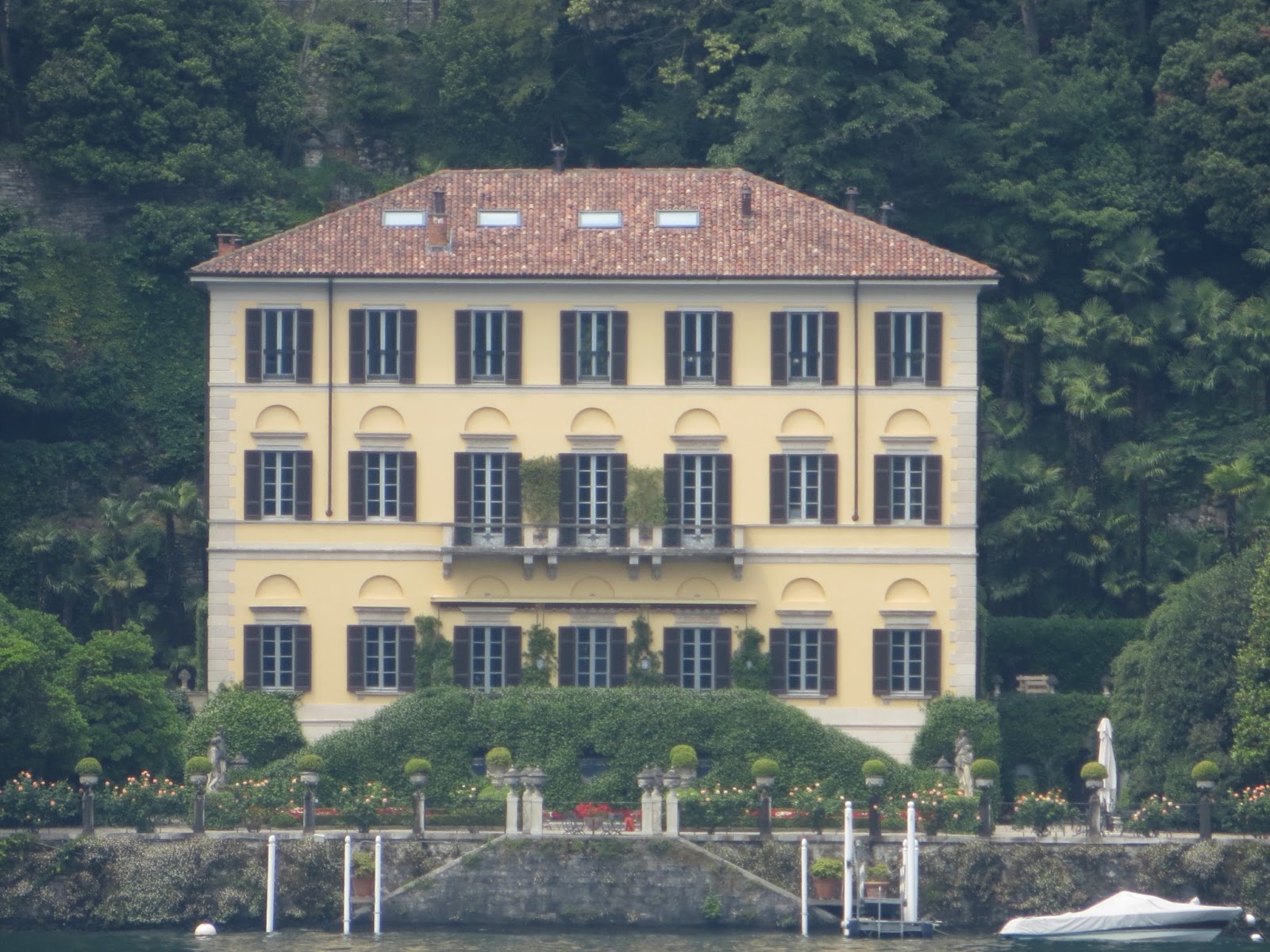
Moltrasio is the next village on the route. One of its most notable residences is Villa Fontanelle, former home of Gianni Versace. It was built in 1800 and sold to the Versace family in the 1980's. Madonna was a regular summer guest, and the villa served as the location for Jennifer Lopez's 2001 wedding. Today Villa Fontanelle is owned by a wealthy Russian restaurateur.


Since we didn't have the headphones, we were relying on others to tell us about the sights we were passing. Luckily, a family of four from Minnesota or Wisconsin or some other friendly midwestern state, excitedly relayed everything. We gradually came to realize that we all took the slow ferry for the same reason: George Clooney. From the beginning, before we even pulled out of the dock at Como, some middle-aged women behind us were daydreaming about the possibility of seeing him.

"Do you think he'll be home, Shirley?"
"Well, I don't know. It's summer time and this is where I'd be if I had a villa in Italy. I'm sure the chances are good, Evelyn."
"I can't wait to meet him!!"

I freely admit that I had my camera poised and ready to capture George at Villa Oleandra. Perhaps his girlfriend and maybe even his good friends Cindy Crawford and Brad Pitt would be sipping wine with him on a veranda. They would wave happily at our ferry, filled with throngs of tourists snapping photos like paparazzi. And then, miraculously, George would signal to me. He would hold up a sign reading, "I know it's your birthday! We're having a party for you! Please, come over!" And I would jump off the ferry and swim across Lake Como gracefully, like Esther Williams. George, Cindy, and Brad would pull me up from the water and envelop me in a luxurious robe with my initials stitched onto the front. Then they would give me presents and we would have dinner at Villa d'Este.

I'm not crazy like all the other women on the ferry; I didn't put too much thought into a chance meeting with George.

Villa de Clooney
I had been snapping photos of every large and semi-large villa we passed, thinking it must be his. I thought Versace's house and a few other estates along the way might be it. I should have known that there would be no doubts when it actually happened. We were sailing along smoothly when all of a sudden the headphone-wearing female passengers collectively gasped and ran to one side of the ferry. The boat rocked precariously as the horde of women took hundreds of photos and waved excitedly at the villa. The American teenage girl we were sitting behind turned to us and breathlessly said, "The guide just said that if his boat is docked outside, it means he's either here or on his way! Eeeeeek!" And I freely admit that I "eeeked" with her and ran over to the side facing his house so he could see my birthday face.

Alas, we never saw George. I think some of the women convinced themselves that he was home but maybe he was just in the shower or grocery store. Otherwise he surely would've invited a gaggle of Canadian, American, Australian, and various European admirers into his estate. It's amazing how far-reaching his celebrity is.

Next up was Villa La Cassinella in Lenno. It's the property of Virgin mogul Sir Richard Branson and reportedly rents for a cool 80,000 Euros per WEEK. But it comes with all the fancy trimmings one would expect for that price tag: a chef, concierge, English-trained butler, a hidden infinity pool, and state-of-the-art cinema. I'm considering staying there next time, if George & Co. are out of town of course.
Villa La Cassinella
The James Bond Villa, or Villa La Gaeta, lorded over us next in San Siro. Casino Royale was filmed here in 2006. The Bond lifestyle can be yours-- luxurious apartments inside the villa are available for rent.


One of my favorite properties was the Grand Hotel Tremezzo in Tremezzo. It's a 5-star property dating back to the early 1900's. Meticulously-landscaped gardens surround the palace and the lake views must be stunning. I'd love to take a dip in the floating pool!

Grand Hotel Tremezzo

After the architecture-overload, we finally arrived in Bellagio. We had several hours to spend in town before catching another ferry back to Como. It was already after noon and we were starving, so we decided to find a good place for lunch. We walked away from the tourist-lined streets and vendors selling postcards and ended up on a charming side street. As we made our way up the cobbled steps, a low-hanging wooden sign caught our attention. We glanced inside Enoteca Cava Turacciolo and immediately decided we'd found our spot.


It felt as if we were walking into a private wine cellar. The damp air smelled ancient but the dark atmosphere was lit by glowing candles and festooned with fresh flowers-- cozy and welcoming. Another reason we decided to stay was the boisterous laughter emanating from a room deep in the cellar. A large party was having a wine tasting and also, from the sounds of their mirth, the time of their lives. We sat down at a high-top for two near the entrance and were immediately waited on by a friendly woman. We decided to have a tasting of 3 reds and 3 whites, along with some champagne to start. We paired it with local cheeses, pastas, and olives.

It became evident to us that the large party in the back was a whole bunch of Americans. It sounded like they hailed from Oklahoma or Texas, based upon their accents and figures of speech. Their laughter was our soundtrack as we sipped and nibbled and, I must say, it was nice to hear my fellow countrymen having such a grand time. It reminded me of some of the positive attributes of Americans. I think (very generally, of course), we are friendly, open, inviting, welcoming, and yes- loud. But sometimes noise is appropriate, especially if it's happy noise. And the owners of the cellar were also very happy because every single American in that group spent several minutes choosing wines to be shipped all the way back to the states. It was a win-win for everyone.

Bellagio is a small resort so we kept running into them after we'd all left Enoteca Cava Turacciolo. We heard them before we saw them, their voices always animated and cheerful with lots of, "Ooooooh! Did y'all see that?!" and, "Wow, I ain't never seen a place like this in my life!" They reminded me of home, and made me miss it.

We spent a long time at the wine tasting so we ended the last hour in Bellagio with a walk around the waterfront. We cooled down with some tasty gelato as we watched ferries and boats come in and out of the harbor. The highlight of our harbor-watching was seeing a bride and groom in a taxi-boat on the way to Varenna.


We took the fast ferry back to Como. It cut the travel time down to 40 minutes so we were there in time for dinner. The concierge at our hotel recommended a restaurant close by called The Market Place. We didn't have reservations but the staff found a spot for us in the small dining room. The kitchen was open and we watched the chef carefully and lovingly prepare and inspect each dish before it went out to patrons. We chose the 50 Euros tasting menu, paired with international and Italian wines. It was amazing! The dishes were original and inventive. The lasagnette with potato and leeks was particularly delicious. All of the staff were incredible and it was a great value. All in all, a remarkable meal and one of my favorites in recent memory.

I was sad to leave the sunny shores of Lake Como. The wine, food, sights, and people made for an unforgettable vacation and birthday. Though we didn't meet George Clooney, running into all of the Americans in Bellagio was just as exciting. Who needs George and James Bond when you're already in a dream world of inexpensive wine, creamy gelato, delectable pasta, mountains, a deep blue lake, and sunny skies.

Molte grazie, Lake Como! And give my regards to George.

Thursday, June 27, 2013

Como, Italy and Lugano, Switzerland

Hotel Borgo Antico
Buongiorno! I spent a few days with a friend in Como, Italy for my birthday. Apparently we chose the perfect time to visit; several locals told us that the weather had been dismal just a few days before our arrival. Luckily for us, it was sunny, warm, and beautiful during our entire stay!

Before this, my only exposure to Italy was Milan for this past New Year's. We had a wonderful time but Milan is certainly a "business" city. It wasn't really the Italy I imagined: coastal, filled with beautiful and friendly people, and lots of delicious pizza and pasta. I'm so glad I was able to see a different city in Italy. Though Como is only 40 miles away from Milan, it feels like a different country.

We flew into Bergamo and took first a bus and then two trains to reach Como. Our hotel was just a five minute walk to the train station. Hotel Borgo Antico has only been open for a few months and it was absolutely perfect for our stay. The value is unbeatable and breakfast is included. Staff were eager to please and the property is extremely secure, with a 24-hour desk attendant who buzzes guests into the hotel after hours.

Duomo in Como
We spent our first afternoon eating lunch on a terrace in the historical center of Como. I didn't have one bad meal in Como and the wine (I mostly had house whites/reds) was fabulous! I was grateful for the reasonable prices. Maybe it's because I just returned from Santorini and felt slightly robbed. Anyway, it was a pleasant surprise.

There are lots of shops in Como stocking the usual touristy items, but also many upscale boutiques selling the fashionable image of Italy. We browsed around in a few and if I had the dough, I would've definitely purchased a Gucci gown from Tessabit... you know, for all of those film premieres and private parties at Villa d'Este.

We had a lovely lunch of pizza and prosciutto with fresh melon the next day. This was fuel for our journey up to the top of Como on the funicular. The views were stunning and it was actually my first time on a funicular. Como's has been operating since 1894. The walls of the waiting area at the bottom are filled with old photos from a time gone by, when the funicular was operated by steam engine and female passengers wore long, billowing skirts and fancy hats.


After our bird's eye view of the lake and Alps, we decided to take a quick train ride to Lugano in Switzerland. We didn't know much about Lugano but we thought the side-trip would be a fun way to spend the afternoon. Before we knew it, the sparkling waters of Lake Lugano stretched before us, framed by a mountainous backdrop.

Lugano

As we made our way down to the lakeside from the station, we happened upon the Cathedral of San Lorenzo. The cathedral was founded in the early Middle Ages. It was under serious restoration but windows were strategically placed in the plastic partitions and we could still look in and get an idea of what the church looked like without all of the construction. Fortunately one small section wasn't covered in scaffolding. The frescoes on the ceiling were breathtaking.


Next, we strolled down the Lakeshore Promenade toward Belvedere Garden. Lots of people were out, lounging in chaises while reading, napping on blankets in the sun, and playing ultimate frisbee. It was a beautiful, lush park with playgrounds, lots of trees, and spectacular views of the lake and mountains.


The day was coming to an end and we had to catch a train back to Como for dinner. Lugano was lovely and I'm really glad we went, even if just for an afternoon.

Newspaper Art in a Lugano Tunnel

Our final day in Como was next. It involved wine, some rowdy Americans, and George Clooney.

Ciao! Ciao!